
LEED v5 recognizes Canadian alternative for bird friendly design
Green Building Team on April 24, 2026
- Rating System/Standard
- LEED
- LEED v4
- LEED v4.1
- LEED v5
- Theme
- Certification essentials
- Green Building
LEED® v5 refocused the rating system on three impact areas to serve today’s market needs: decarbonization, quality of life, and ecological conservation and restoration. This last pillar has seen a few important updates, one of which has long been desired by some in the industry to see formally recognized as a requirement for green buildings: good bird-friendly design.
It has been calculated that each year approximately 25 million migratory birds die in Canada due to collisions with buildings (Machtans, C.S. (2013), “A First Estimate for Canada of the Number of Birds Killed by Colliding with Building Windows”, Avian Conservation and Ecology 8(2):6). According to Fatal Light Awareness Program (FLAP) Canada, during the daytime, birds do not see the glass itself, but only what is behind it or reflected on it. If trees or plantings are reflected on the glass, this can attract birds to fly directly into those windows. Some birds see themselves reflected and, believing their reflections to be competing birds intruding on their territory, might fly into the window to “attack”. Both of these types of daytime collisions are most likely on the areas of glazing from ground to the top of the surrounding mature tree canopy or on glass guard rails, such as those surrounding green roofs.
Additionally, many bird species migrate at night and the artificial light from our buildings can confuse birds and pull them from their migration paths to locations where they might collide with buildings.
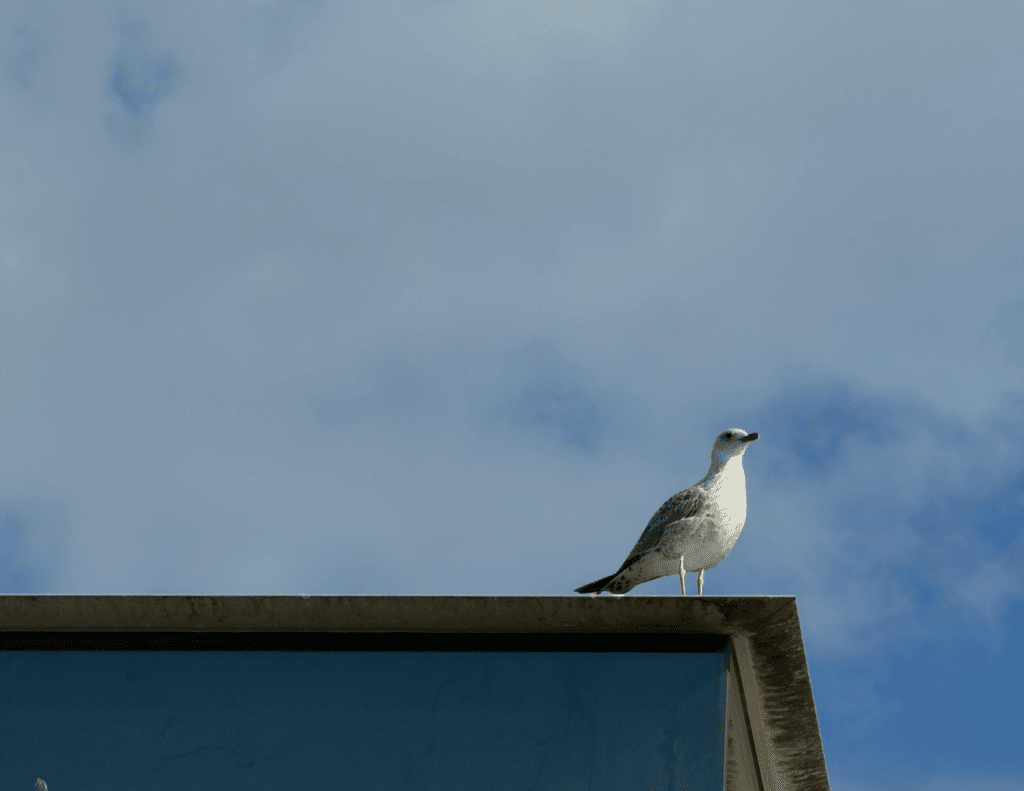
Since the 1970’s, it is estimated that North America has lost 30% of its bird population (source: https://www.3billionbirds.org/). This loss is significantly concerning as birds provide a vital role in their ecosystems, managing the over population of pest insects and enabling the spread of seeds through their habitat ranges and migration. Additionally, the solution for bird safe design can be inexpensive to implement. The design can add interest and beauty to a building; it need not interfere with aesthetics or functionality. Generally, addressing bird safe design means incorporating a dense pattern of visual markers on glazing on specific elevations. “Dark sky” lighting design, long addressed in a separate LEED credit, is also important to limit light pollution that disrupts birds during their nocturnal migrations.
In LEED v5, new options to credits encourage project teams to address bird friendly design
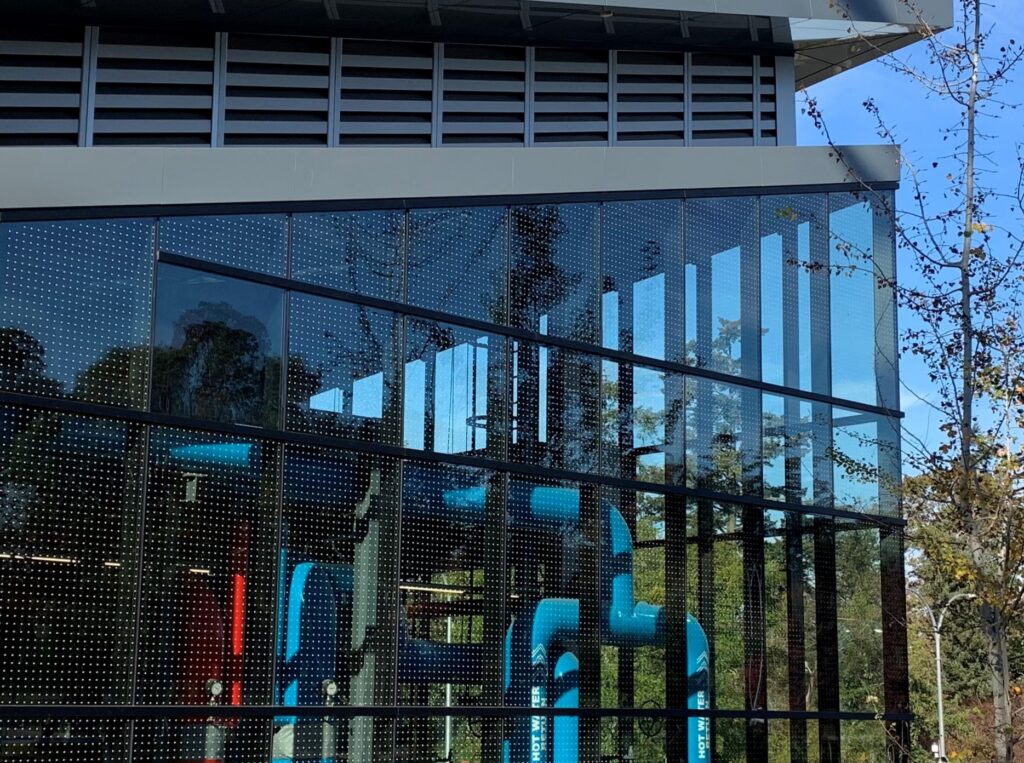
University of Victoria District Energy Plant, LEED Canada for New Construction and Major Renovations 2009, Gold
In LEED v5, new options to credits within LEED Building Design + Construction (BD+C) and Operations + Maintenance (O+M) encourage all project teams to address bird friendly design in their projects.
Both SS credit 1: Biodiverse Habitat – Option 2 – Bird-Friendly Glass and LEED v5 O+M SS credit 2: Light Pollution and Bird Collision Reduction – Option 2 – Bird Collision Reduction, incorporate a new option to utilize glass that is considered more ‘bird-friendly’ at specific elevations of the building. The requirement is to use only glass that has a maximum threat factor of 30, defined by the American Bird Conservancy (ABC)’s Threat Factor (TF) analysis. ABC developed this system to evaluate material based on the potential threat to birds and provide a rating. Scores are assigned and tracked in a database, providing project teams the opportunity to find glazing solutions for their buildings. ABC offers two testing locations in North America, both located in eastern USA: one in Maryland and one in Pennsylvania, each with a capacity to test 20-30 windows each year.
Canadian alternative for bird friendly design
In Canada, a group of experts, including representatives from FLAP Canada, the City of Toronto, and Environment and Climate Change Canada, worked together to develop an alternative approach to bird-friendly design, focusing on a prescriptive list of window treatments to reducing bird collision rather than requiring glass be tested. Their guidance was released in CSA A460:19 (R2024) Bird-Friendly Building Design, available in both French and English, and free for online viewing in Canada. This Canadian standard also goes beyond glass treatment to investigate site design and vegetation, building integrated structures (e.g., shading), and lighting. These supplementary areas of this standard, however, are addressed in other LEED credits and requirements.
The CAGBC is pleased to highlight the work of these Canadian experts in a Regional Alternative Compliance Path (ACP) for LEED v5 projects in Canada: RACP15 Bird-Friendly Design in Canada. In Canada, project teams are still welcome to use the requirement as written in BD+C and O+M, with the ABC Threat Factor rating, or instead, the requirement can be met where a project team demonstrates that the following sections of CSA A460:19 (R2024) Bird-Friendly Building Design (or later version) are met on the project: Section 3.2 (on Required elevation treatment) and all parts of Section 3.3 (on Glazing). The standard provides prescriptive measures on visual markers, which include size, density pattern, contrast and glass surface, and fly-through conditions, which include balcony railings, glass corners and parallel glass. By listing these prescriptive measures, it allows project teams the flexibility to utilize local Canadian glass suppliers whose glazing may not have undergone the ABC threat factor testing. Many project teams will find these measures familiar as some Canadian municipalities have adopted bird friendly design requirements. For example, Toronto has been requiring bird friendly glass treatment since 2010, driving the development of a range of glazing products that deter bird collisions.
LEED v4 and v4.1 BD+C projects interested in considering bird-friendly design are directed to a similar requirement under the Innovation: Bird Collision Deterrence. The approach for this credit is slightly different from the LEED v5 direction. Project teams wishing to utilize an alternative approach for the Threat Factor requirement within this innovation must reach out to LEED Coach Canada.