
Healthcare, schools and other unique project types in LEED v5
Green Building Team on April 29, 2026
- Rating System/Standard
- LEED
- LEED v5
- Theme
- Certification essentials
LEED v5 Building Design + Construction (BD+C) has been devised with a new streamlined approach to project type variation, reducing complexity. Most projects, regardless of the project type (healthcare, school, retail, residential, data centre, warehouse, hospitality, office, etc.), can certify under BD+C: New Construction and Major Renovation (NC). These project types can use LEED v5 BD+C: NC if at least 60 percent of the gross floor area is complete. Those that have at least 40 percent of the floor area incomplete, another path is offered: Core and Shell (CS), and projects may use different types under this rating system.
LEED v4 BD+C offered eight variations in the rating system, including ones specific to healthcare, schools, data centres, warehouses, hospitality and retail. While this approach was devised to provide a clear path for specific project types, some clients found the differing structure between the project types more challenging to manage and struggled to determine which path was most suitable for projects that simply didn’t fit clearly within one definition. One of the requests CAGBC committees made on behalf of the Canadian market during the Future of LEED sessions was to simplify and streamline LEED v5 where possible, and so, this has been done with project type variations.
Simplicity of project type variations was also applied to the LEED v5 Interior Design + Construction (ID+C) and LEED v5 Operations + Maintenance (O+M).
How is project type variation handled?
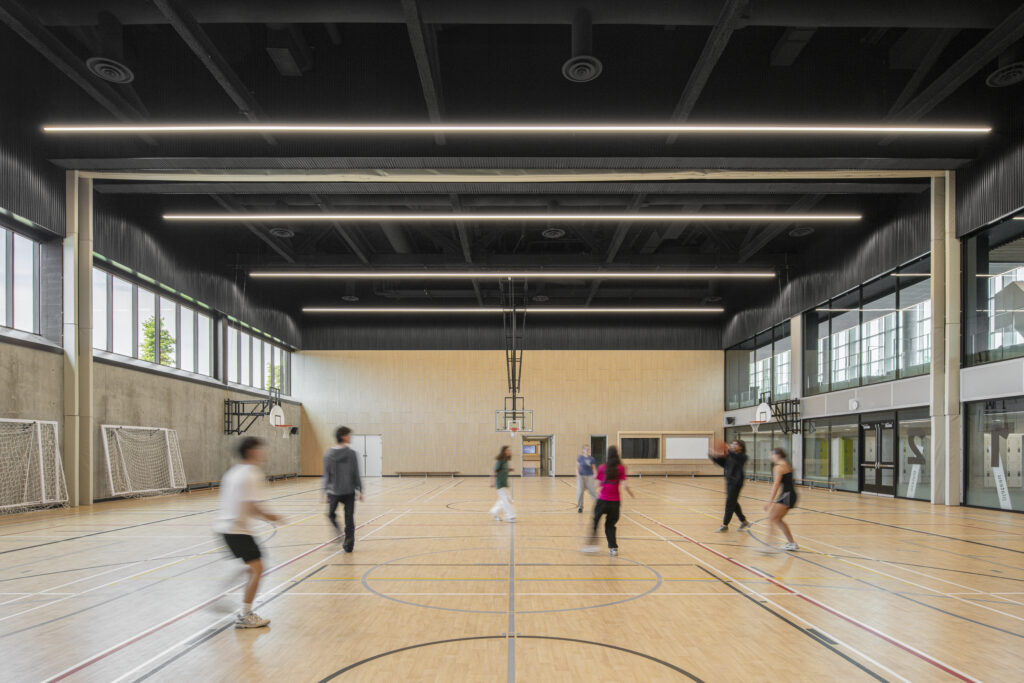
Photo: David Boye, Lemay, Leclerc, Prisme in consortium
Project type variation is now handled within the prerequisites and credits, where needed, for project types such as schools, warehouses, healthcare, retail, residential or data centres. For example, under LEED v5 BD+C LTc3 Compact and Connected Site, there are separate paths for schools and for data centers, warehouses and distribution centers. Additionally, as noted in the introduction to the LEED v5 reference guides, project type requirements must be met if 60 percent or more of the gross floor area of a project comprises that project type. Guidance is also provided for BD+C projects with incomplete space; the use type of the incomplete space must be based on the expected future use in determining the project type variations. Lastly, there is supplementary guidance for mixed use projects within some credits, such as LTc4 Transportation Demand Management with bicycle storage.
It should be noted that LEED v4.1 O+M included an Interiors project type variation where LEED v5 O+M will focus solely on whole-building certification.
What about credits unique to a project type?
Under LEED v4, there were additional credits only available to specific project types. These additional credits are now being built out in the Project Priority Library. They are available for additional points under the nine points available within the Project Priority credit, or where indicated, as alternative compliance paths to existing credits. For example, the popular Places of Respite, which over 70 percent of Canadian LEED v4 BD+C Healthcare projects achieved, is available for LEED v5 healthcare projects under Project Type Credits. More project type credits are expected in the future.
Healthcare Project teams might also be interested in USGBC’s article: What does health care look like in LEED v5? (March 2026).