
Decision-makers convene at CAGBC’s sold-out Green Building Business Summit
75+ industry leaders discuss how decarbonization and climate resilience are shaping value, risk, and competitiveness in commercial real estate
CAGBC Staff on March 3, 2026
- Theme
- Green Building
On February 26, the Canada Green Building Council (CAGBC) welcomed senior decision-makers to the sold-out Green Building Business Summit in Toronto. Sponsored by Royal Bank of Canada (RBC) and Arup, the executive-level event brought together owners, developers, investors, lenders, and portfolio leaders to explore how climate era issues such as transition risk (compliance with evolving regulations, and performance requirements) and physical risk (climate-related impacts) reshaping asset value, risk management, and long-term competitiveness.
As the commercial real estate sector faces rising investor expectations, intensifying regulatory pressures, and tenant demand for climate-aligned assets, it is being asked to deliver on measurable building performance. The Summit sought to equip leaders with decision-ready insights that reflect how climate risk are evaluated in executive and investment settings, helping align sustainability strategies with financial and capital planning decisions.
“At CAGBC, our focus is clear,” said Brent Gilmour, Chief Commercial Officer. “We ensure the market has the tools, frameworks, and credibility needed to deliver climate-aligned buildings, attract capital, preserve asset value, and contribute to competitiveness and business value.”
Climate risk as financial risk
The summit opened with a conversation on how capital markets are responding to climate alignment and investor expectations. As markets increasingly prioritize climate resilience and decarbonization, aligning financial strategy with building performance becomes a critical driver of asset value.
“Quality assets attract more investor interest,” Gilmour said. “They broaden the tenant pool and reduce churn. They’re viewed as lower risk by insurers and lenders. And they’re simply more resilient—physically and financially.”
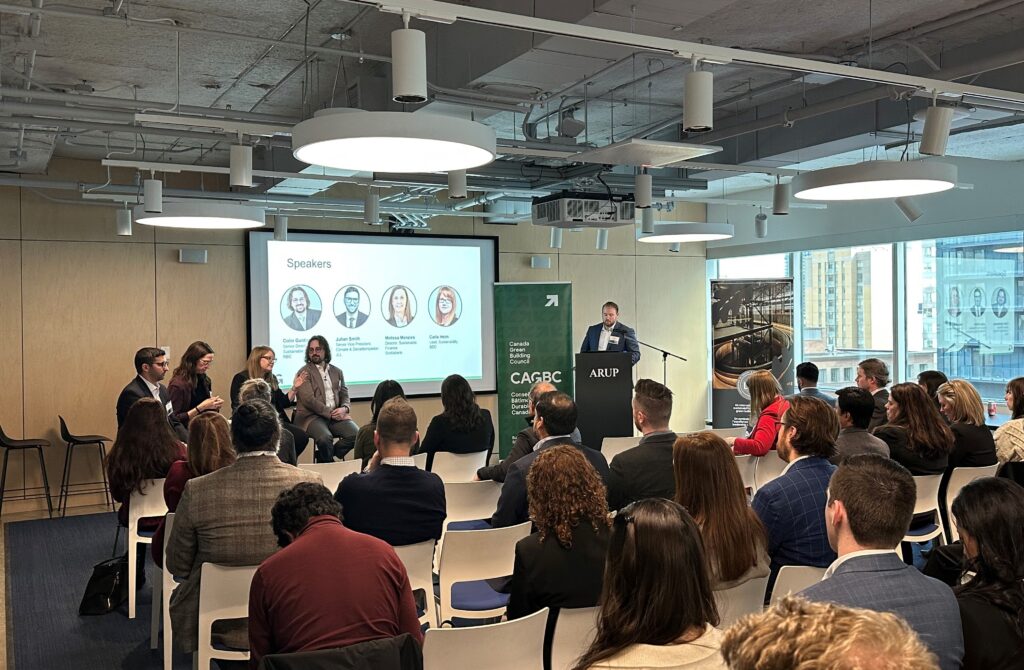
Expert panelists, including Julian Smith, JLL; Colin Guldimann, RBC; Carla Heim, BDC; and Melissa Menzies, Scotiabank, highlighted how risk-return profiles and climate pricing are increasingly driving investment decisions – and how early project engagement, better data, and standardized metrics are needed to support lending and appraisal. They agreed that green loans, bonds, and other sustainable finance tools must reflect risk and performance while meeting regulatory and insurer requirements. “If we can unlock ROI, we can unlock lending,” one panelist stated.
Decarbonization as a competitive advantage
Featuring Jenny McMinn from Urban Equation, Karen Jalon of Cadillac Fairview, and Ecovert’s Michael Guadagnoli, this panel reinforced that decarbonization is now critical to risk management and competitive advantage, evolving from building-by-building approaches to portfolio-wide strategies. The panel emphasized that using data-driven insights to guide capital planning, measure carbon, and track progress, combined with proactive planning, recommissioning, and deployment playbooks, enables efficient delivery of climate-aligned buildings.
“Sustainability remains core – what’s changing is that the market is increasingly engaging through a risk-and-resilience lens” Gilmour stated.
Resilience driving valuation and capital decisions
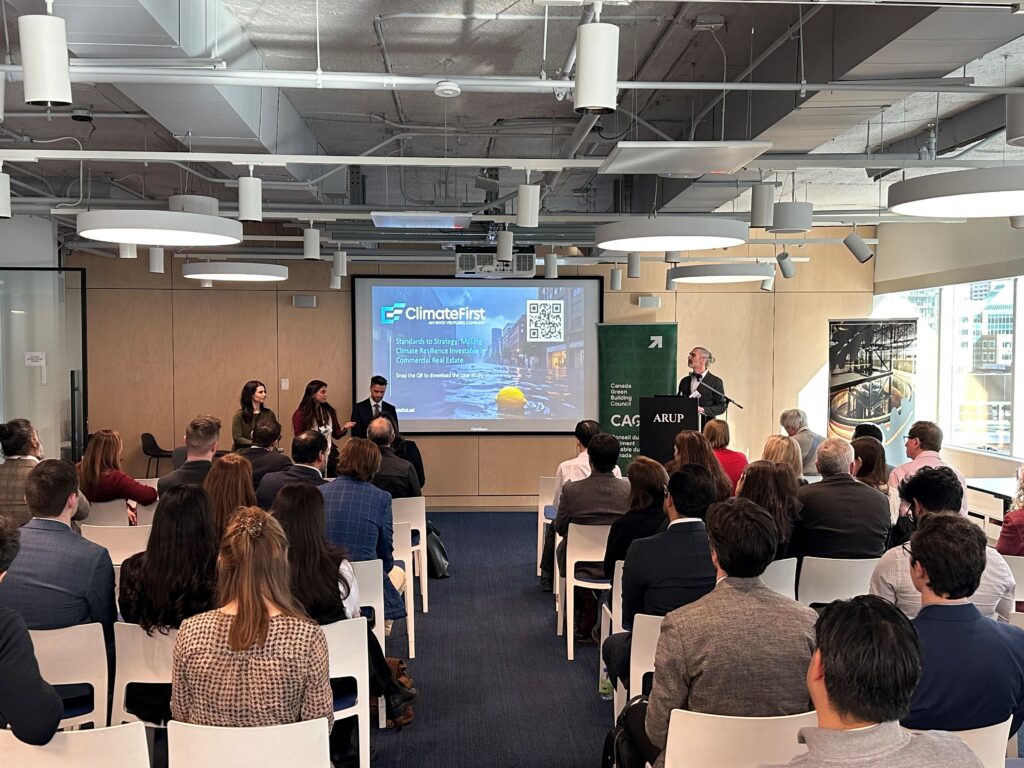
As resilience becomes an immediate business need amid visible risks in underwriting, insurance pricing, and portfolio strategy, the “from Standards to Strategy” panel explored how physical climate risk is shaping valuation and capital allocation, and how standards like LEED v5 can help. Panellists Angela Adduci, BMO Climate Institute; Kit Milnes, KingSett; Ridhima Nayyar, RioCan; and Hamoda Youssef, Olivia Pink and moderator Mike Williams, all from ClimateFirst highlighted the importance of business approaches that link resilience investments to financial outcomes to reduce volatility, protect asset value, and strengthen long-term stability. The role of standards was shared in LEED case studies from the BMO Climate Institute and Investment Management Corporation of Ontario (IMCO), demonstrating how LEED v5 resilience requirements can translate climate risk into financial planning.
“Standards are part of asset preservation,” said Gilmour. “We’re operating in a period where expectations are rising, and the performance bar is moving. Quality assets attract more investor interest, and increasingly, the market wants that quality to be verifiable. That’s where trusted standards and third-party certification come in – they can help reduce friction and enable better decision-making.”
Building skilled workforce capacity
The Summit concluded with a discussion on Canada’s green building workforce capacity. David Photiadis, Delphi Group; Laura McDonough, Future Skills Centre, Della Wang, Fengate Asset Management; and Mohammed Haque, Mattamy Homes emphasized that resilient and zero-carbon buildings cannot scale without skilled professionals who can deliver retrofits, verify performance, and optimize operations. They highlighted the need for early workforce planning, modernized training and apprenticeship models, and pathways to build a diverse and capable workforce. They stated that workforce development must be treated with the same long-term discipline as capital planning, embedding zero-carbon literacy across all levels and making sustainability knowledge a baseline of competency, not a specialized add-on.
“The commercial real estate sector faces increasing pressure to demonstrate measurable, climate-aligned performance,” said Gilmour. “What was clear from this Summit is that climate risk, resilience, and decarbonization are no longer side conversations; they’re influencing how capital is allocated, how assets are valued, and how portfolios are managed.”
CAGBC thanks all sponsors and panel participants.
Join the conversation
The dialogue continues at the Canada Green Building Council’s annual conference, Building Lasting ChangeRM (BLC), taking place June 17–19, 2026 in Montréal, QC. Designed specifically for real estate executives, investors, and portfolio decision-makers, the Business Stream examines evolving expectations around decarbonization, resilience, and verified performance and how they influence valuation, investor confidence, and access to capital.