
Ronald McDonald House – Maritimes
Halifax, Nova Scotia
March 14, 2026
- Rating System/Standard
- Zero Carbon Building
- Certification Level
- Certified
- Building Type
- Multi Residential
| Certification year | Rating System | Version | Level |
|---|---|---|---|
| 2023 | ZCB-Design | v3 | Certified |
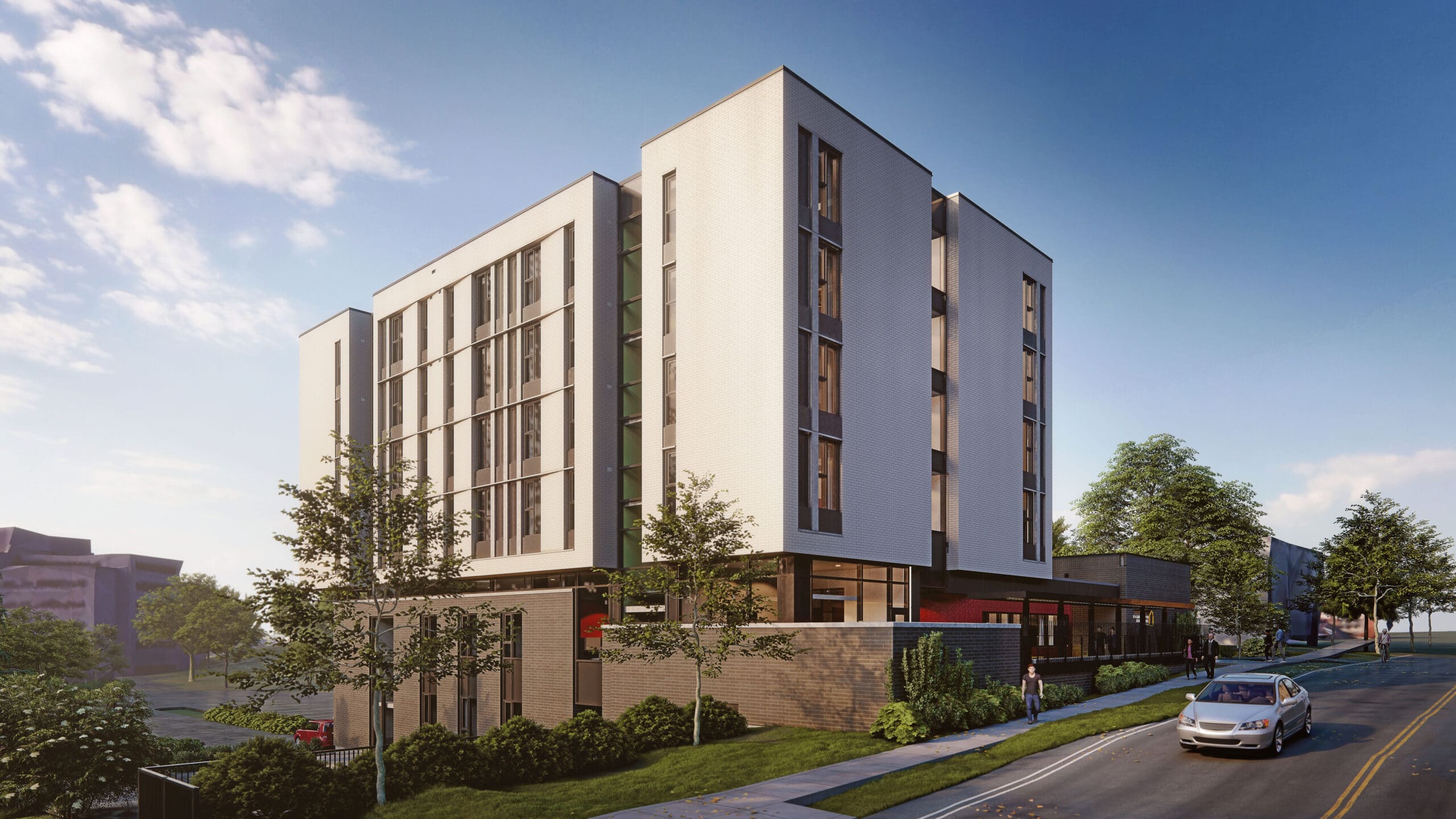
Ronald McDonald House Maritimes is a six-storey building located at 5940 South Street, Halifax, Nova Scotia. It’s one of 16 Ronald McDonald Houses across Canada, a program providing a home-away-from-home for families traveling with a child receiving treatment or in a serious medical condition. Replacing an aging structure that had reached its capacity, this new facility is certified under Zero Carbon Building – Design (ZCB-Design) version 3.
Case Study Team
- Project Owner/Developer
- Ronald McDonald House Maritimes
- Certification Consultant
- Integral Energy Performance
- Architect
- Lydon Lynch
- Energy Modeller / Building Performance Engineer
- Integral Energy Performance
- Mechanical Engineer
- M&R Engineering/BPA
- Electrical Engineer
- M&R Engineering/BPA
- Civil Engineer
- Able Engineering
- Structural Engineer
- Structural Engineer Campbell Comeau
New house, new hopes
With twice the capacity of its predecessor, the new Ronald McDonald House features 36 residential units, including four larger suites with two-bedroom apartments with a kitchen space for families with long-term stays or immunocompromised children. It is also equipped with a suite of thoughtfully designed amenity spaces, and service rooms spread over a total conditioned floor area of approximately 4,000 m².
These amenities provide much sought-after residential accommodation, but also recreational spaces to maintain a warm living environment and emotional support for patients and their families. The new building will be able to serve an additional 700 families per year and offer 6,570 more nights of comfort for patient families.
Building on lessons learned from the old Ronald McDonald House, minimizing distance from the hospital, enhancing accessibility, and increasing capacity were determining factors for the new site. Unlike the old site, a repurposed existing house, the new one is located across the street from the Izaak Walton Killam health centre, a major women’s and children’s hospital and trauma hospital in Halifax, making it easier for families to stay at their little ones’ bedside. The new facility is designed to be fully wheelchair accessible, ensuring convenient access for patients and families with mobility challenges.
It pays to go green
While the primary design goal was to create a supportive, home-like environment for families during their care journey, the project team also wanted to promote a resilient and sustainable community. As a charitable organization, Ronald McDonald House Maritimes needed to optimize funding resources to achieve these goals, and that’s where pursuing CAGBC’s ZCB-Design certification became pivotal in the development of this project.
The certification was instrumental because it fulfilled one of the eligibility conditions for financial support under the federally funded Green and Inclusive Community Buildings Program (GICB). It also ensured an energy-efficient design that would set up the building for low operations and maintenance costs. The Government of Canada also invested $4 million in this project through the Community, Culture, and Recreation Infrastructure Stream (CCRIS) of the Investing in Canada plan.
The new Ronald McDonald House in Halifax is a perfect illustration of optimization, considering the multifunctional spaces, how energy systems complement one another, and how external financial resources were pulled together to deliver a building that will serve such a diverse population.
Jennifer Punch, CEO, Ronald McDonald House Maritimes
Maximizing energy efficiency through synergy
In order to meet its operational emissions-free target, the new Ronald McDonald House Maritimes employed a unique mechanical design approach that yields a fully electrified building, a popular choice on projects seeking a ZCB-Design certification.
The design relies on thermal and solar power to cover the building’s energy requirements. The building’s heating/cooling system is based on a closed-loop geothermal field composed of twenty 500-feet-deep geothermal wells, serving floor heating via water-to-water heat pumps and water loop heat pumps in residential spaces. The main and lower-level common areas are served through a horizontal water source heat pump for heating and cooling systems anda central heat recovery ventilator for ventilation. L2 to 5 Corridor pressurization is also served by the central heat recovery unit. The domestic hot water system of the project is served by an air-to-water heat pump with a supplemental electric DHW heater. The heating, cooling, and ventilation system serving floors 3 to 6 is through a vertical water source heat pump with an integral energy recovery ventilator.
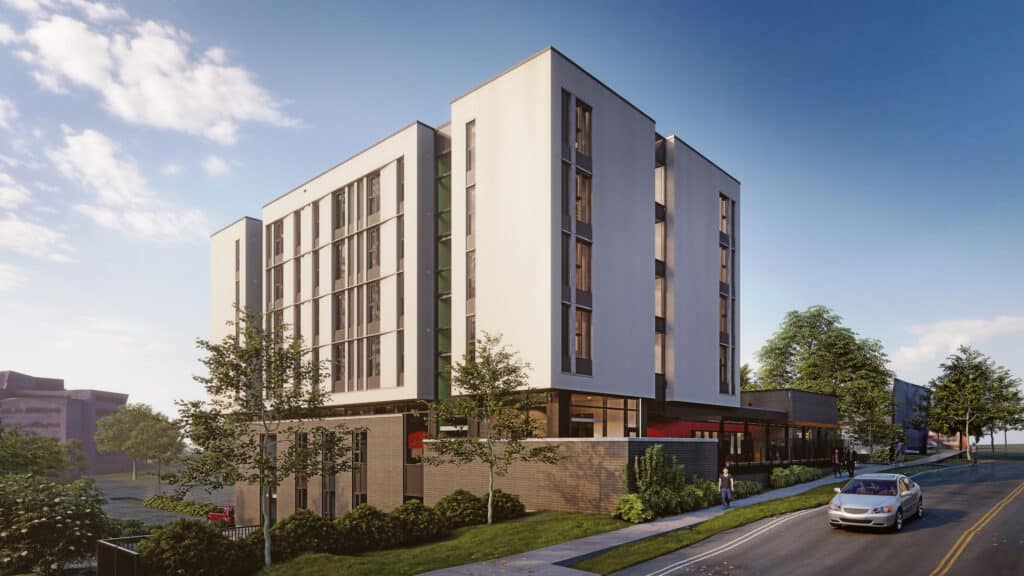
The building’s heating/cooling system is based on a closed-loop geothermal field composed of twenty 500-feet-deep geothermal wells
The building’s thermal energy demand intensity is reduced through optimized envelope design and high-performance energy recovery ventilation throughout the building. Occupancy and daylight sensors will also help minimize lighting energy use. This yields a building that operates with no onsite combustion for space and water heating and has reduced energy costs compared to a standard-efficiency design. The project is also integrating on-site power generation through a rooftop equipped with solar panels and is expected to produce as much as 20 percent of the electrical requirements for the building, resulting in an expected 60 percent energy cost savings compared to code. The system includes 212 375-watt solar modules, oriented East/West, equating to a 79.5 kW DC solar array. The solar modules will be paired with a DC optimizer (two modules per optimizer) to ensure optimal power production and production monitoring. The optimizers then connect to 4x SolarEdge inverters, making up a 60.9 kW AC potential power output. The system is estimated to produce 67,318 kWh of renewable energy in its first year of production.
The rooftop solar system is expected to produce as much as 20% of the electrical requirements for the building, resulting in an expected 60% energy cost savings compared to code.
A warm, healing experience
While functionality, increased occupancy, and sustainability set the foundation for the new Ronald McDonald House, the design’s ultimate purpose is to provide a warm, healing experience for patients and their families. To avoid any resemblance to a clinical or hospital environment, every aspect of the new Ronald McDonald House was carefully crafted to foster a cozy, homelike atmosphere.
Materials selection was given key consideration to allow for a welcoming space that supports mental well-being and healing. The project team carefully selected residential-type materials to evoke a sense of familiarity and accentuate this feeling of comfort in a welcoming building. The building’s exterior walls are predominantly covered in brick, a cladding material widely used in dwellings. The building has a lot of windows to bring in daylight and offer views to the courtyard and green spaces beyond, a design that reduces the use of artificial light and energy consumption, improves comfort, but more importantly enhances patients and families’ overall well-being and circadian rhythm, a regulator of the immune system.
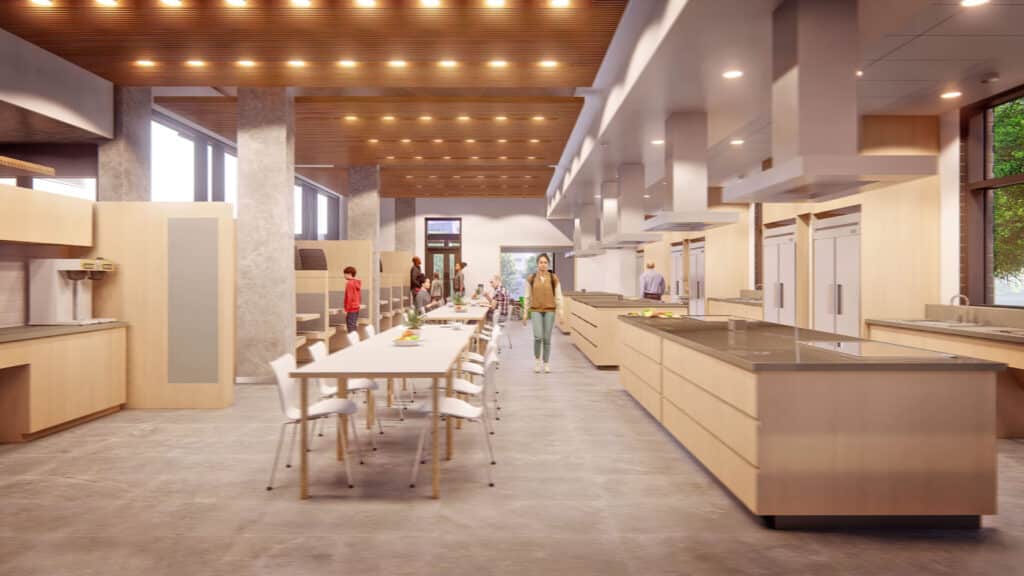
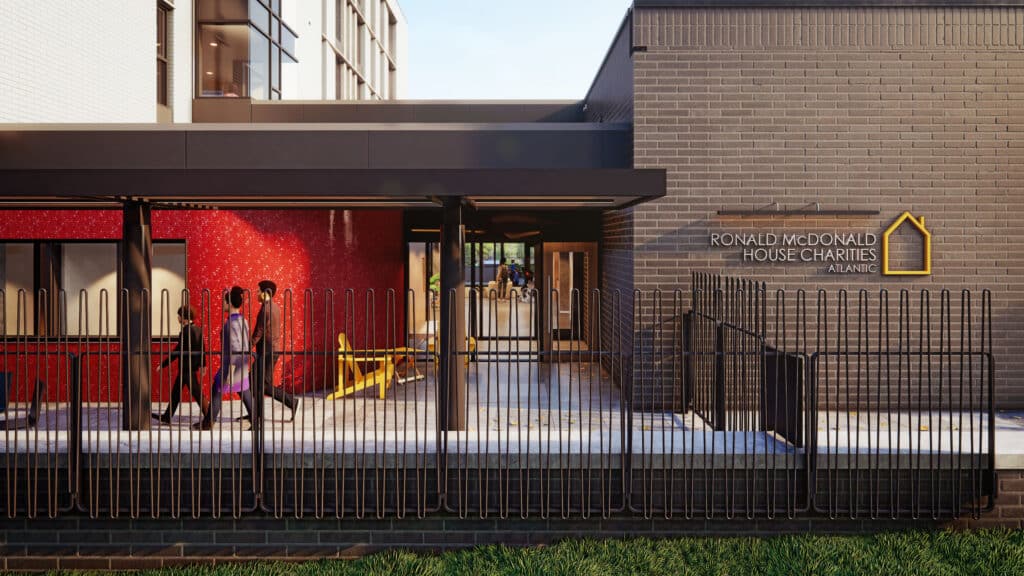
This connection to nature extends beyond the building itself to the thoughtfully designed courtyard. Modeled after a university –style quadrangle, the courtyard creates an outdoor sanctuary away from the surrounding city and hospital. Expected to be operational early 2025, the ground floor will feature administrative and common spaces, such as activity rooms, a parlor, play areas, lounge space, and a shared kitchen and dining room – all arranged around the courtyard to encourage a sense of comfort, connection and community.
By achieving Zero Carbon Building – Design, Ronald McDonald House has proven once again that every building type can pursue the highest green building standards without compromising on functionality or overspending. There’s a boulevard of opportunities for new builds and deep retrofit projects willing to take the first step in futureproofing their assets.
Mark Hutchinson, Senior Vice President, Green Building Programs & Innovation, CAGBC