
Streamlined path to LEED v5 with Passive House certification
- Rating System/Standard
- LEED
- LEED v5
- Theme
- Certification updates
- Green Building
Owners might find value in achieving Passive House certification to guide and demonstrate focused reductions on energy efficiency, mostly through exemplary envelope performance. The owners who also want to harness the whole-building comprehensiveness of LEED will find LEED v5 and Passive House certification systems complimentary. The USGBC now offers a pilot Alternative Compliance Path (ACP) that streamlines achievement of some of the most rigorous credits in LEED v5 BD+C, for projects that achieve passive house certification under Passive House Institute (PHI) or the Passive House Institute US (PHIUS). Both of these programs are used in Canada.
Certified Passive House projects can achieve these credits:
EAc1 Electrification as long as the project has no on-site combustion except for emergency support systems. (for five points)
EAc2 Reduced Peak Thermal Load for which Passive House’s airtight, low-thermal-bridge envelope essentially delivers by design. (for five points)
EAc3 Enhanced Energy Efficiency for the six points for the regulated-load energy. Project teams can also achieve up to four more points available for plug and process loads using Option 1, Path 2.
The pilot ACP is available under EApc184 Passive House ACP.
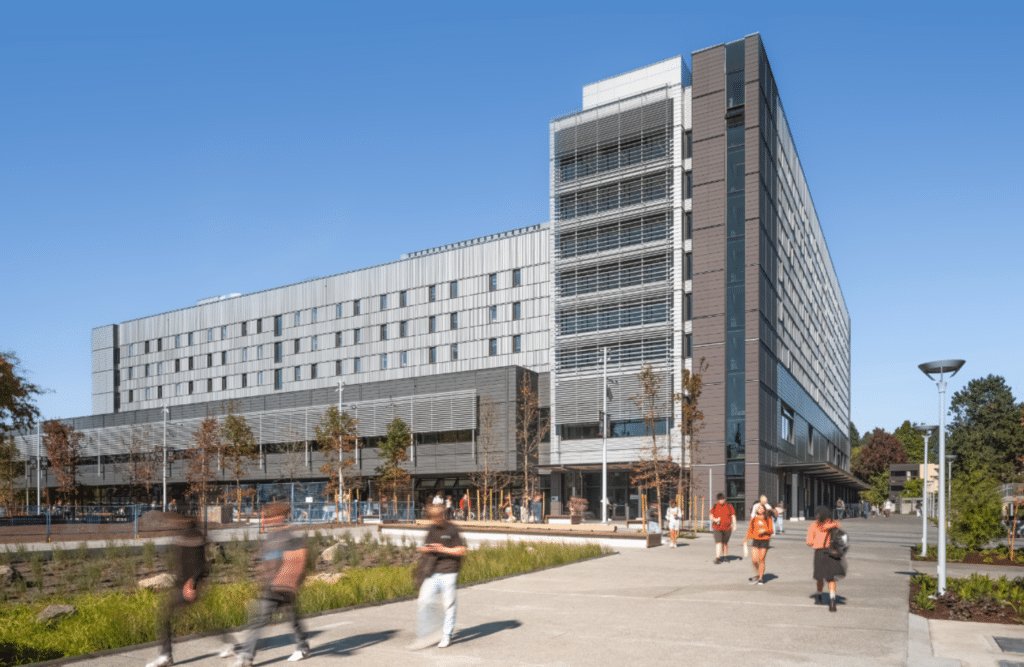
LEED v4 BD+C: New Construction, Gold and Passive House Certified
For projects pursuing Passive House, that work becomes a streamlined onramp to LEED’s toughest credit area, and LEED, as a wholistic rating system, then captures everything Passive House doesn’t reach.
CAGBC LEED Advisory Committee member, Jason Packer, Director of Sustainable Development at CIMA+, sees both LEED v5 and Passive House certification interest with his projects in BC. He notes “For projects pursuing high-performance outcomes, Passive House and LEED v5 can complement each other very well. Passive House certification helps project teams demonstrate meaningful reductions in energy demand, peak thermal loads, and operational carbon, while LEED v5 recognizes those outcomes as part of a broader holistic framework for sustainable building performance.”
| Passive House | LEED v5 | |
| What it measures | Energy & envelope performance | Whole building: decarbonization, quality of life (including health and resiliency), and ecological conservation and restoration |
| Energy & operational carbon | Ultra-low heating/cooling demand via an airtight, high-performance envelope | Covered – and a Passive House project can earn full/near-full points here via the above-mentioned ACP |
| Embodied carbon & materials | Not addressed | Embodied carbon of structure, envelope, and site hardscape required; significant points for reductions; additional points to address other aspects of building materials |
| Indoor environment & health | Considers comfort and ventilation (energy-driven) | Broader: air quality to current ASHRAE 62.1, occupant experience, daylight, accessibility, and more |
| Resilience & climate adaptation | Overheating criteria and air filtration | Required climate resilience assessment plus resilient-design credits |
| Water, site & ecology | Not addressed | Water efficiency, rainwater management, habitat, location attributes, and more |
| Verification | Third-party, focused on energy & airtightness | Third-party, across all of the above |